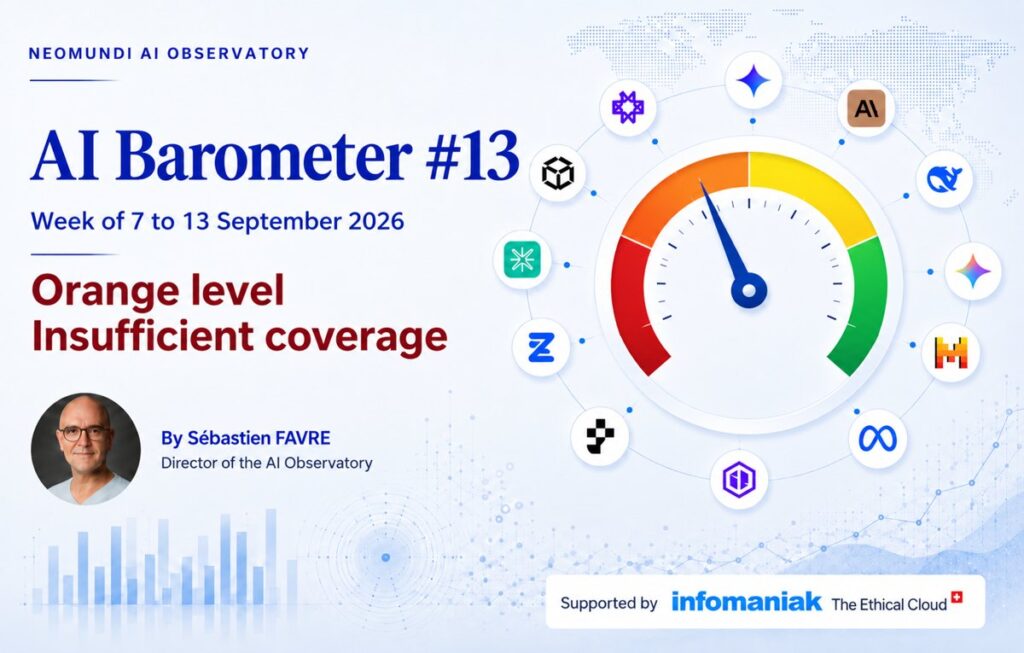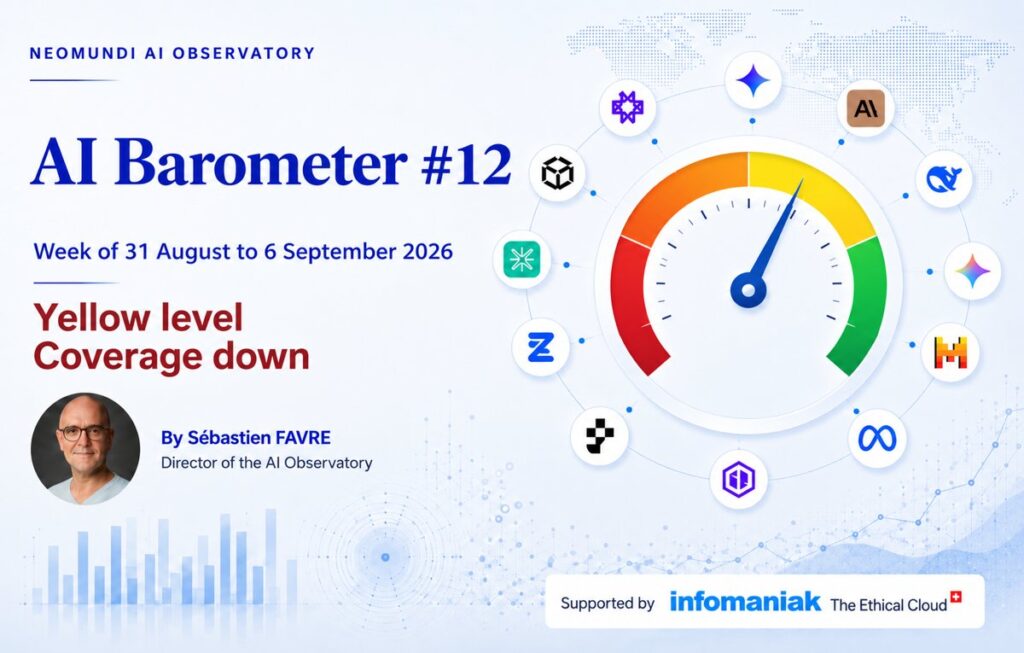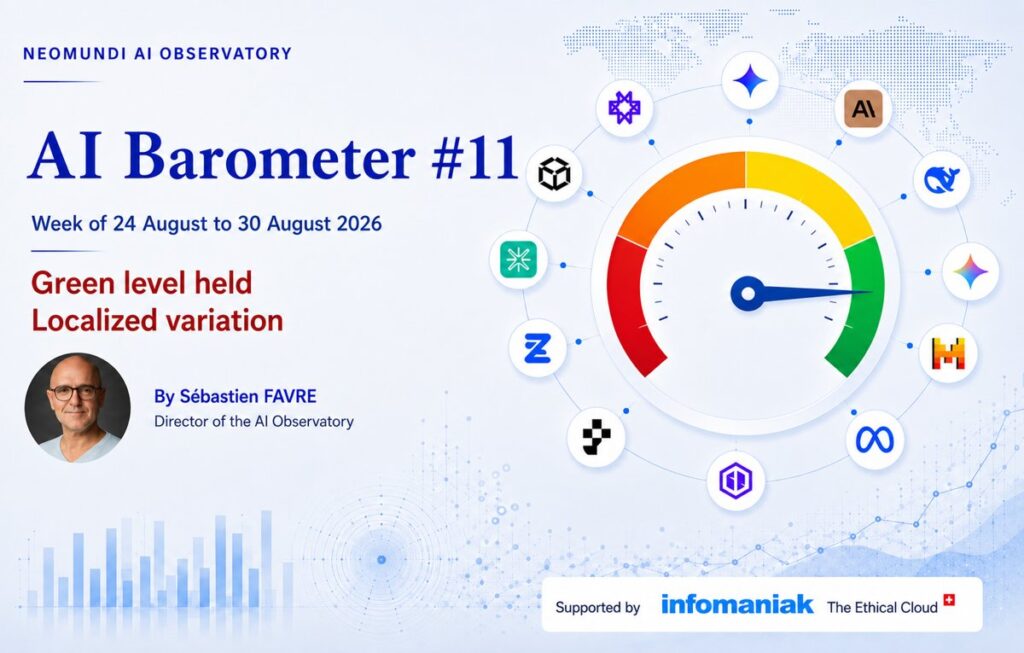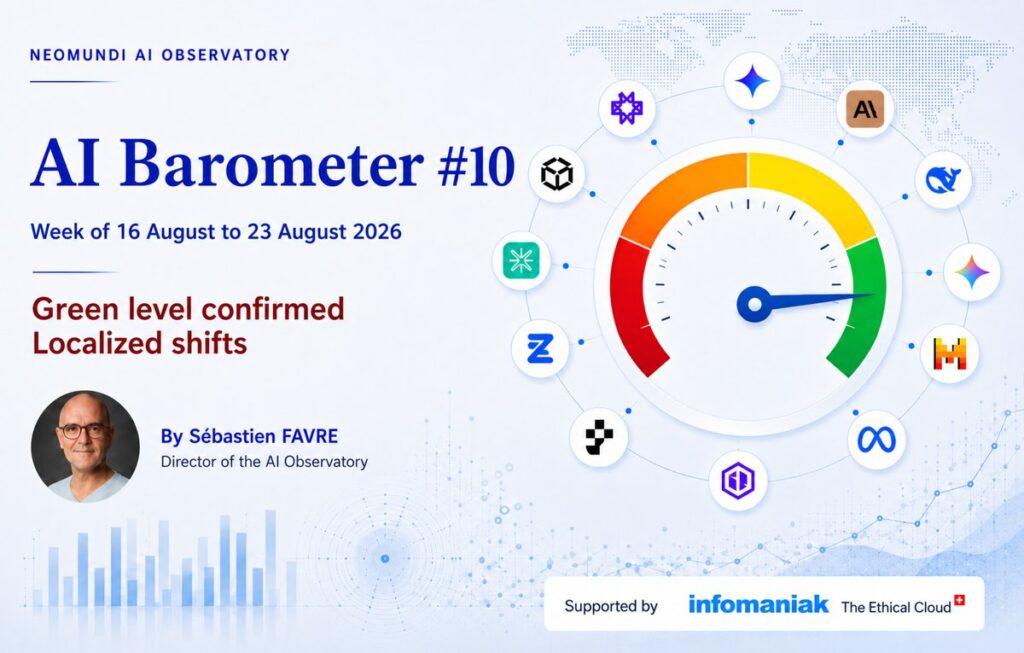
Author name: Sébastien FAVRE

Sébastien Favre-Lecca is an artist-researcher and founder of NeoMundi Research. He is developing a real-time measurement framework for generative AI systems to make their behavior more observable, auditable and governable. His work focuses on generation stability, drift, information density, factual validity and AI governance infrastructure.

The AI Cartography of July 2026
AI Observatory

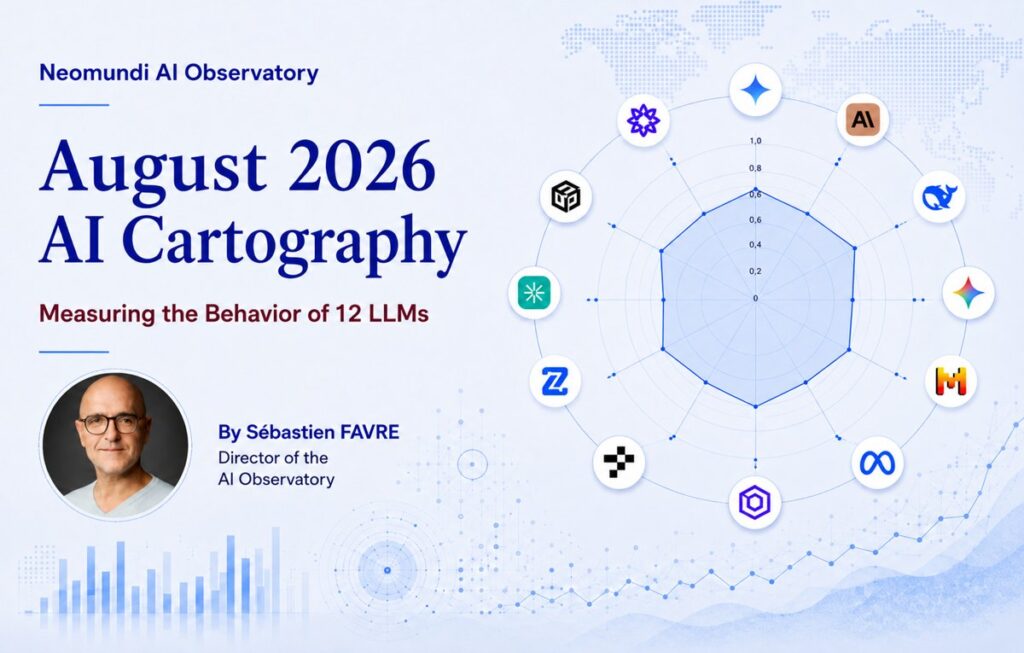
July 2026 AI Cartography: Measuring the Behavior of 12 LLMs

⚠️ The first version of this Artificial Intelligence cartography combined two distinct protocols: a large-scale campaign conducted on twelve profiles (LLMs) submitted to 790 questions from TruthfulQA, and a complementary campaign based on twelve profiles, three categories of questions and 150 observations per category.This combination made it possible to observe multiple dimensions of system behavior […]

The 4th AI Barometer of NeoMundi's AI Observatory, July 6-12, 2026
AI Observatory

AI Barometer #4 – Week of July 6-12, 2026

All AI Barometers When an AI responds consistently… but no longer says exactly the same thing This week, the Barometer highlights a particularly subtle form of instability: for the same question, the same system can generate multiple plausible, well-written, and seemingly logical responses… while varying the conclusion, nuance, or level of caution. None of the

NeoMundi AI Barometer #3 - June 30 to July 6, 2026
AI Observatory

NeoMundi Barometer #3 – Week of June 30 to July 6, 2026

All AI Barometers When a response sounds perfectly solid… but still warrants verification This week, the Barometer highlights a particularly insidious phenomenon: responses formulated with confidence, plausible at first glance, yet containing precise factual errors. Answers that many readers might accept without question. This is exactly what our measurement instrument detected on multiple occasions. Three

Baromètre des IA NeoMundi #2 semaine 26 de juin 2026
AI Observatory

NeoMundi Barometer #2 – Week of June 22 to 29, 2026

All AI Barometers One profile shows a clear shift in zone, while the overall picture remains calm This week, the overall average remains calm. However, one of the observed systems has changed its behavior and triggered our response verification control much more frequently compared to Barometer #1 last week. Indeed, the anonymized LLM with the

NeoMundi AI Barometer #1
AI Observatory

NeoMundi Barometer #1 – Week of June 15 to 21, 2026

All AI Barometers Building a baseline To produce this first Barometer, we first established a public baseline. It was built from 3 execution waves × 12 de-identified systems × 4 fixed questions × 100 repetitions, representing 14,400 completed observations. This baseline serves as the reference point for measuring changes observed in future weekly publications. View

June 2026 cartography, 12 major LLMs measured
AI Observatory

June 2026 cartography: measuring the behavior of 12 major LLMs

1. For AI systems, price, stability and factual accuracy do not always move together We measured 12 major generative AI systems using the same protocol, in order to compare their observable stability, factual validity and relative cost per request. Each point represents an observed profile. Horizontal axis: observable stability · Vertical axis: evaluated factual validity

Distributed autonomous systems can now coordinate trajectories, distribute tasks, and maintain dynamic formations at scale.
AI Observatory

Murmuration

1. MURMURATION – Research on Collective Runtime Stability Distributed autonomous systems can now coordinate trajectories, distribute tasks, and maintain dynamic formations at scale. But one critical question remains largely unsolved: how can we measure the collective stability of a multi-agent system before a systemic failure in cohesion emerges? Current distributed architectures are designed to optimize:

Scroll to Top