AI Barometer
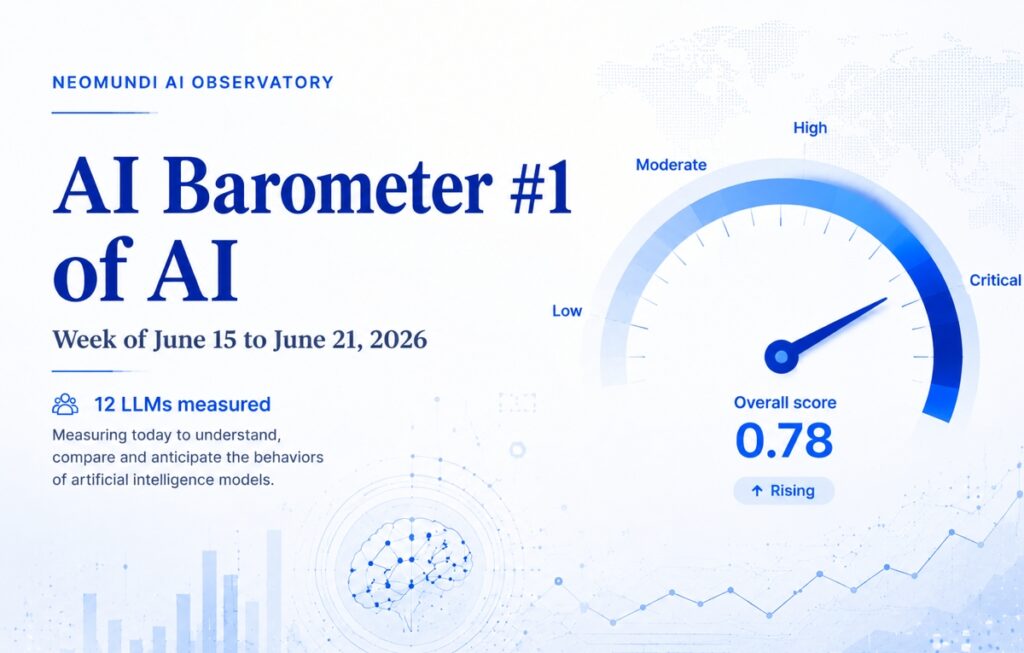
The AI Barometer NeoMundi is our weekly and longitudinal observatory dedicated to the real-world monitoring of generative AI systems behaviors.
Each week, we analyze a panel of 12 anonymized model profiles through 4 fixed questions repeated 100 times each (4,800 executions in total). We measure and score several key dimensions: observable stability, factual validity, information density, factual risk signals, semantic variation and cost efficiency.
These continuous observations help detect behavioral trends, subtle evolutions and silent regime shifts that traditional point-in-time benchmarks cannot capture.
Methodology and public data
This barometer is based on an open, transparent and reproducible methodology. This cartography is generated from aggregated public data by a Python script. The results rely on the NeoMundi public baseline and on the Observatory’s methodology.
The Python scripts, scoring protocols, raw datasets and aggregated results are published on GitHub. The scores are measurement signals, never verdicts or rankings.
Find here all editions of the Artificial Intelligence Barometers, with their detailed analyses and specific observations.
AI Observatory
Reading note — 15 October 2026. This publication reports a June–July 2026 campaign. Figures describe signals recorded by the measurement chain used at the time, not verified error rates or a general assessment of model reliability. Cross-period comparisons require matching protocols, evaluator versions and coverage; they must not be carried over automatically to a later […]
AI Observatory
All AI Barometers Building a baseline To produce this first Barometer, we first established a public baseline. It was built from 3 execution waves × 12 de-identified systems × 4 fixed questions × 100 repetitions, representing 14,400 completed observations. This baseline is the reference for this June 2026 series. Later comparisons require an equivalent measurement