Author name: Admin

NeoMundi Research publishes reports, external audits, and numerous publications regarding AI (Artificial Intelligence, LLM) metrics, produced by the research laboratory and external contributors.

Multi-Signal Analysis for Robust AI Behavioral Monitoring – NeoMundi AI Governance Reference
AI Governance Reference

Multi-Signal Analysis for Robust AI Behavioral Monitoring

Introduction Relying on a single behavioral metric is rarely sufficient for effective AI governance in production. A model may appear stable while showing factual-risk signals, or it may produce coherent outputs that nevertheless drift over time. Multi-signal analysis addresses this limitation by combining several complementary behavioral indicators to form a richer and potentially more robust […]
From Measurement to Action: Building Operational AI Governance Frameworks – NeoMundi Research
AI Governance Reference

From Measurement to Action: Building Operational AI Governance Frameworks

Introduction Measuring the behavior of AI systems is a necessary but insufficient step toward effective governance. Organizations also need structured ways to transform observations into decisions and actions. Without clear frameworks, even high-quality signals risk remaining unused or being interpreted inconsistently. This article examines how organizations can move from behavioral measurement to operational governance. It

Longitudinal Monitoring and Behavioral Drift Detection in Production AI – NeoMundi Reference
AI Governance Reference

Longitudinal Monitoring and Behavioral Drift Detection in Production AI

Introduction AI systems in production are not static. Model updates, provider-side changes, modifications to prompts or retrieval sources, shifts in input distribution, routing changes, or adaptive system components can cause observed behavior to evolve over time. Detecting these changes requires more than isolated evaluations or short-term observations. Longitudinal monitoring provides the temporal perspective necessary to

Deceptive Stability: Definition, Detection, and Implications | NeoMundi AI Governance Reference
AI Governance Reference

Deceptive Stability: Definition, Detection, and Implications

Introduction In AI governance, stability is often perceived as a positive indicator. However, a model can appear stable while still presenting hidden risks or variations. This phenomenon, known as deceptive stability, can lead to a false sense of security and inadequate risk management. This article defines the concept, explains how to detect it, and discusses

Designing Reproducible AI Measurement Campaigns | NeoMundi AI Governance Reference
AI Governance Reference

Designing Reproducible AI Measurement Campaigns

Introduction As AI systems are increasingly used in production environments, the ability to reliably measure their behavior becomes essential. However, measurements that cannot be repeated or verified offer limited value for governance. This is why reproducible AI measurement campaigns are a foundational requirement for any serious approach to AI governance and metrology. This article explores

Understanding Runtime Risk Signals in Deployed AI | NeoMundi AI Governance Reference
AI Governance Reference

Understanding Runtime Risk Signals in Deployed AI

Introduction As AI systems operate in real-world production environments, the ability to detect and interpret risk signals during or immediately after generation becomes essential. These signals, often referred to as runtime risk signals, provide valuable information about the behavior of AI models while they are actively processing requests. This article explains what runtime risk signals

Weekly Barometers vs Monthly Cartographies: Complementary Approaches | NeoMundi AI Governance Reference
AI Governance Reference

Weekly Barometers vs Monthly Cartographies: Complementary Approaches

Introduction Effective AI governance in production requires both the ability to detect short-term variations and the capacity to understand longer-term behavioral patterns. Two complementary approaches have emerged to address these needs: weekly barometers and monthly cartographies. While both methods aim to improve the observability and governance of AI systems, they serve different purposes and operate

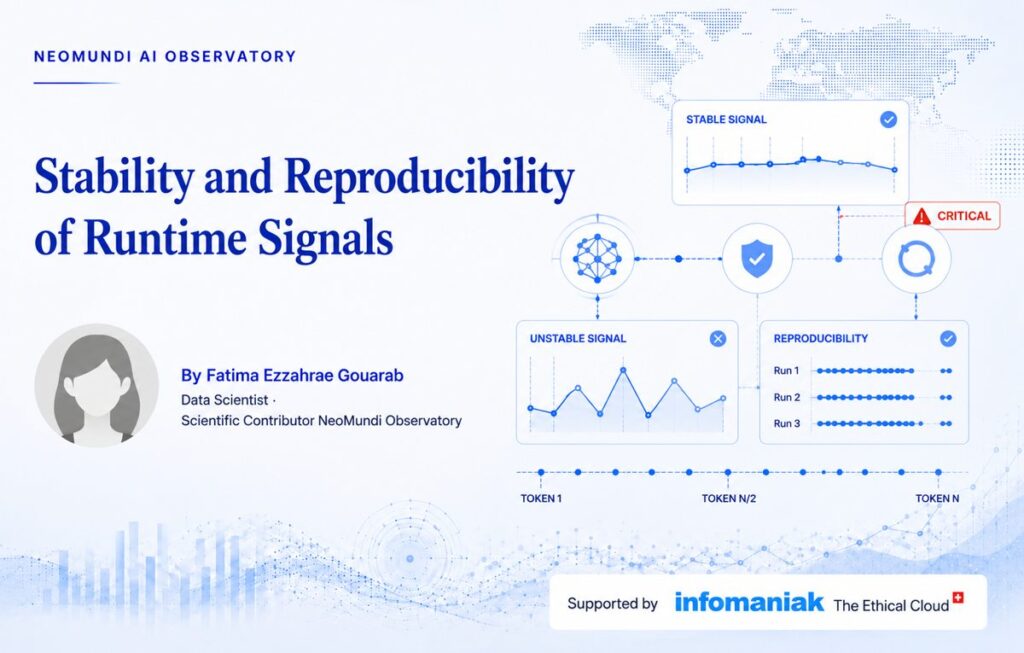
Stability and Reproducibility of Runtime Signals – Fatima Ezzahrae Gouarab – NeoMundi Observatory
AI Observatory

NeoMundi publishes a first study on the stability and reproducibility of its runtime signals

Fatima Ezzahrae Gouarab, Data Scientist, statistician and scientific contributor to the NeoMundi Research Observatory, is conducting work on the stability and reproducibility of the signals produced by NeoMundi ControlTower. DOI : https://doi.org/10.5281/zenodo.21499715 This first experimental phase is based on 680 generations, carried out with three model providers, two generation temperatures and several corpora covering factual

Stability vs Factual Consistency in Production AI | NeoMundi AI Governance Reference
AI Governance Reference

Stability vs Factual Consistency in Production AI

Introduction Two of the most important behavioral dimensions in AI governance are stability and factual consistency. They are related but distinct, and confusing them leads to incomplete risk assessment. This article clarifies both concepts and explains their role in production environments. Defining Stability Stability refers primarily to the consistency of observable generative behavior across repeated

Signal vs Verdict: Core Principle of Responsible AI Evaluation | NeoMundi AI Governance Reference
AI Governance Reference

Signal vs Verdict: Core Principle of Responsible AI Evaluation

Introduction One of the most critical distinctions in AI governance is the separation between signal and verdict. Confusing the two leads to over-reliance on tools, blurred responsibility, and increased operational risk. This article defines the concepts, explains why the distinction matters, and shows how to apply it in practice. Defining Signal and Verdict A signal

Scroll to Top